UMindMap is a lightweight static web application for capturing and organizing ideas without unnecessary complexity. It requires no installation or registration—just open it in any modern web browser. Mind maps are created intuitively using nested lists, while each node can optionally include notes written in Markdown. With a single click, the entire structure is rendered as a clear graphical mind map with all its details. Thanks to its simple text-based format, your data remains easy to read, portable, and fully under your control. Mind maps can also be shared easily without any server-side support—simply upload the application together with the data file to any static web server and append the data file name to the URL as a parameter.
The Ujorm (original name was UJO Framework) is an open source Java small library which provides non-traditional objects based on the key‑value architecture to open up new exciting opportunities for writing efficient code. The Ujorm have got special ORM module designed for rapid Java development with great performance and a small footprint. The key features are type safe queries, relation mapping by Java code, no entity states, and a memory overloading protection cache.
2026-07-24
2026-05-30
What's new in Ujorm 3.0.3?
A new version 3.0.3 is now available. The SelectQuery class fixes SQL INSERT statement generation when using a third chained relation combined with LEFT JOIN. The negation method for Criterion conditions has been fixed as well. The new version significantly speeds up INSERT operations in cases where retrieving the generated ID key is not required, which has a positive impact especially on PostgreSQL performance tests. The library now automatically loads the logging configuration from the ujorm-config.properties file, so SQL queries are printed to the terminal in JUnit tests without any additional setup.
The changelog is available here.
2026-05-15
Ujorm 3.0 is released
Ujorm3 requires Java 17 or higher.
<dependencies>
<dependency>
<groupId>org.ujorm</groupId>
<artifactId>ujo-core</artifactId>
<version>3.0.0</version>
</dependency>
<dependency>
<groupId>org.ujorm</groupId>
<artifactId>ujo-orm</artifactId>
<version>3.0.0</version>
</dependency>
</dependencies>https://github.com/pponec/ujorm/#-ujorm3-library
2026-03-23
Ujorm3 RC1 Released
Links:
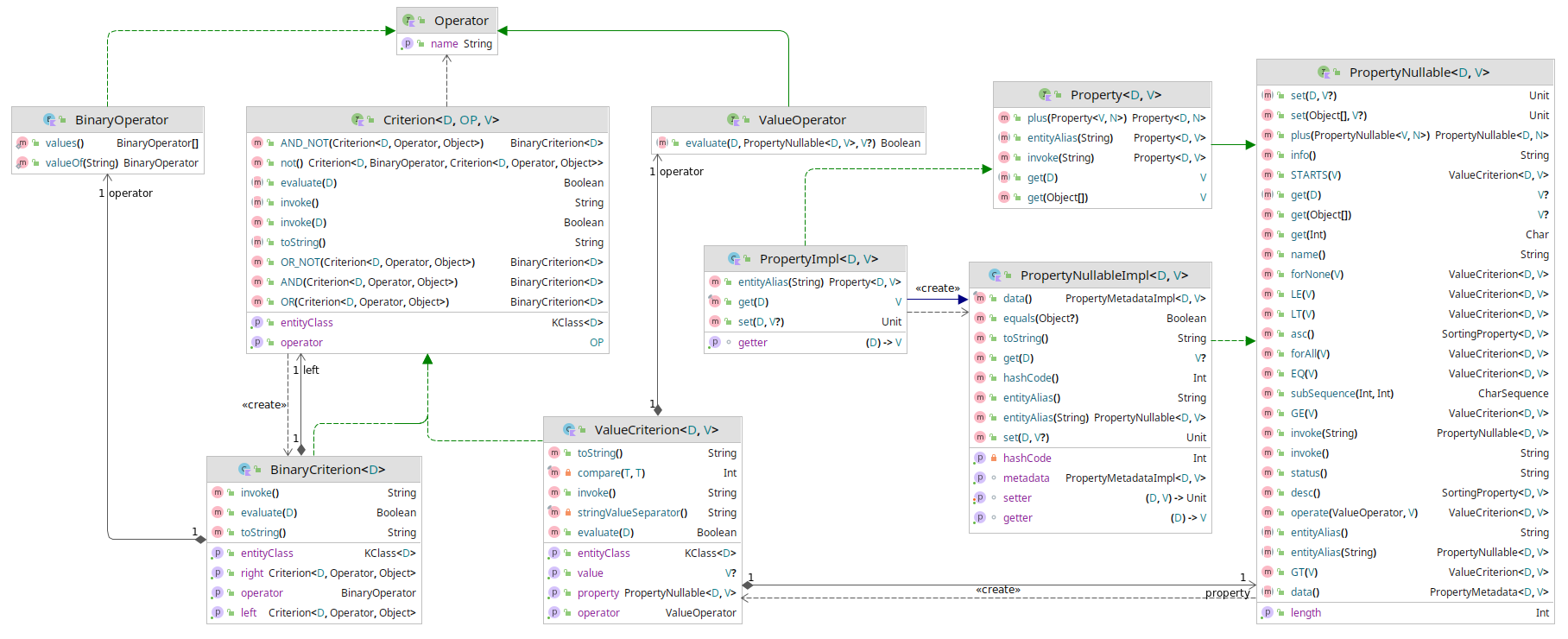
Simplified API schema:
2026-03-08
Ujorm3 (a new lightweight ORM framework for JavaBeans and Records)
I have prepared a completely new implementation of a lightweight ORM in pure Java that works with JavaBean and Record objects. More details will follow gradually. For now, I am just attaching a link to the project's homepage:
And also a link to the performance tests, which can be used as a reference for your own implementations:
Comments and feedback are welcome :-).
2024-11-06
Ujorm release 2.26
<dependency>
<groupId>org.ujorm</groupId>
<artifactId>ujo-web</artifactId>
<version>2.26</version>
</dependency>
2023-06-07
New ORM Framework for Kotlin
An article about a Kotlin API for ORMs was published on DZone.
See a sample of the SELECT statement:
Links:
2022-02-19
Home home page for a Ujorm WEB module.
The Ujorm module for creating HTML pages using pure Java code has its own homepage:
2021-07-06
Ujorm for Kotlin?
A very early prototype of the Kotlin library for modelling filters using a domain object meta-model.
Assembled filters work on common POJO objects.
The solution was inspired by the Ujorm key-value framework, but this code is completely new.
Topical areas of use are:
- dynamic validations
- alerting
- modelling conditions for ORM
See more information: https://github.com/pponec/ujormKt
2021-06-21
A mini Java web application with a size about 5 MB.
I managed to build a web application with a size of only 5.18 MB.
The application contains only a short HTML form with support for simple AJAX events. The project is built on the Javalin framework and a web module from the Ujorm framework.
The source code is freely available on GitHub:
https://github.com/pponec/demo-ajax/tree/javalin
2021-05-25
Java HTML Report in a Few Lines of Code
I’d like to show you a simple table HTML report created with only thirteen
lines of source code, written in a single command line using the Java
programming language. Let’s pretend the data provision service already
exists.
See the full articles on DZone:
Screenshot:
2021-04-26
A Simple AJAX Website in Java
During the Covid New Year of 2020, I created a simple prototype website using AJAX, with the goal of moving Java developers away from JavaScript and ideally also text-based HTML templates. I made my original solution a little more general, moved certain parts into the Ujorm framework, and am presenting the result here for your further inspiration.
See the full article: https://dzone.com/articles/a-simple-ajax-website-in-java
2019-05-13
The Story of Ujorm Framework
Somewhere back in 2008, I had an opportunity to participate in development of an interesting transport reservations system written in Java. The frontend was built on RichFaces, a former component framework for Sun Microsystems' JavaServer Faces, a business logic was placed into service classes managed by Spring framework, persistent layer was built on Hibernate ORM framework.
See the full article on Github ...
2018-12-12
How to Effectively Work With a Relational Database Using Java JDBC
The full atricle:
https://dzone.com/articles/how-to-effectively-work-with-a-relational-database
2015-02-18
Repository changes
hg clone http://hg.code.sf.net/p/ujoframework/code ujorm
2014-04-27
Key-value Coding in Java
- Writing and reading values
- Restoring default values
- Shallow copy of an object
- Validation attributes when writing
- Composite Keys
- Criterion as a condition model
- Criterion for filtering collection
- Collection sorting
- Serialization of Keys
- Import from CSV format
Short examples are based on the Ujorm library.
http://ujorm.org/sample/key-value.html
2014-03-11
Ujorm version 1.44
- XML configuration of an ORM meta-model can be validated using a XSD file
- and there is available a new module (ujo-xsd) to generate XSD files accoridng an UJO class
- ORM supports native DB sequences using the class NativeDbSequencer
- ORM lazy loading can be enabled (optionally by a parameter) on the closed session too, for the case an action opens a new DB connection for a necessary short time only
- there was removed the interfaces Property, which has been deprecated since version 1.30 and should be replaced by a new interface Key (including related methods)
2013-10-01
The CRUD application for Ujorm and Wicket
I would like to present a small web project for hotel booking to show an interesting features of the Ujorm library. Graphical interface is rendered by the Apache Wicket framework.
See the next screenshot of the form dialog including a source code:
To be continued ...
2013-01-20
Ujorm 1.32 released
- the new validators are available for checking a consistency of the input values. The Ujorm validators have got a similar meaning for Ujo object how the Bean Validation (JSR 303) implementation for the JavaBeans. For more information see the the documentation or a jUnit tests.
- the ORM supports reading a related database tables by the one SQL request using an extended implementation of the Query object. More information are described in ORM user guide.
2012-12-11
Ujorm 1.31 released
- database statements UPDATE or DELETE supports entity relations in the Criterion - including batch mode
- SQL entity and column names can be "quoted" optionally in the real SQL statements, for more information see the method: MetaParams.setQuotedSqlNames()
- the one critical bug is fixed for some cases of the lazy loading
- explicitly defined Key name created using a factory is fixed now
- there is available the new great plugging to NetBeans IDE to generate getters and setters easy for UJO - thanks to Martin Mahr